Page 1 of 83
[Non-content page]
Page 2 of 83
Module - 4 Environmental chemistry
Water Technology
- Water is used for various purposes such as industrial, domestic, drinking etc.
- It is a universal solvent.
- In industry water is used as a solvent and coolant for various purposes.
Hardness
- The property of water which prevent lather formation with soap.
- It occurs due to the presence of salt of Ca, Mg and other heavy metals dissolved in water.
Chemical explanation A sample of hard water when treated with soap (sodium or potassium salt of fatty acids), insoluble salts of Ca or Mg forms and these salts appear as white precipitate.
Hard water and soft water
Hard water - Water which does not produce lather with soap solution readily, but forms a white sticky precipitate.
Page 3 of 83
Soft water - water which lathers easily on shaking with soap solution.
Types of Hardness
| Temporary Hardness | Permanent Hardness |
|---|---|
| $ | |
| ightarrow$ bicarbonates of Ca and Mg | $ |
| ightarrow$ sulphates and chlorides of Ca and Mg | |
| $ | |
| ightarrow$ can be removed by boiling | $ |
| ightarrow$ can be removed by chemical process. | |
| $ | |
| ightarrow$ known as carbonate hardness or alkaline hardness | $ |
| ightarrow$ known as non carbonate hardness or non alkaline hardness. |
Disadvantages of Hardness
Domestic purpose (drinking) not used for washing and bathing purpose because it leads to the Textile industry. It is not used sugar industry Concrete mixing it is not used If hard water is not used for in boilers because it cause boiler corrosion
- the standard used to express hardness
- The most insoluble salt that can be precipitated in water treatment.
- A standard solution of hard water can be prepared by using
- Molecular mass of is 100, so the calculations easy
Page 4 of 83
-
Temporary hardness (carbonate)
-
Permanent
<u>Units of hardness</u>
- ppm
- mg/L
- clarke's degree
- Degree trench
- Milliequivalent / L
Page 5 of 83
A water sample contains of per litre. Calculate the hardness in terms of equivalence?
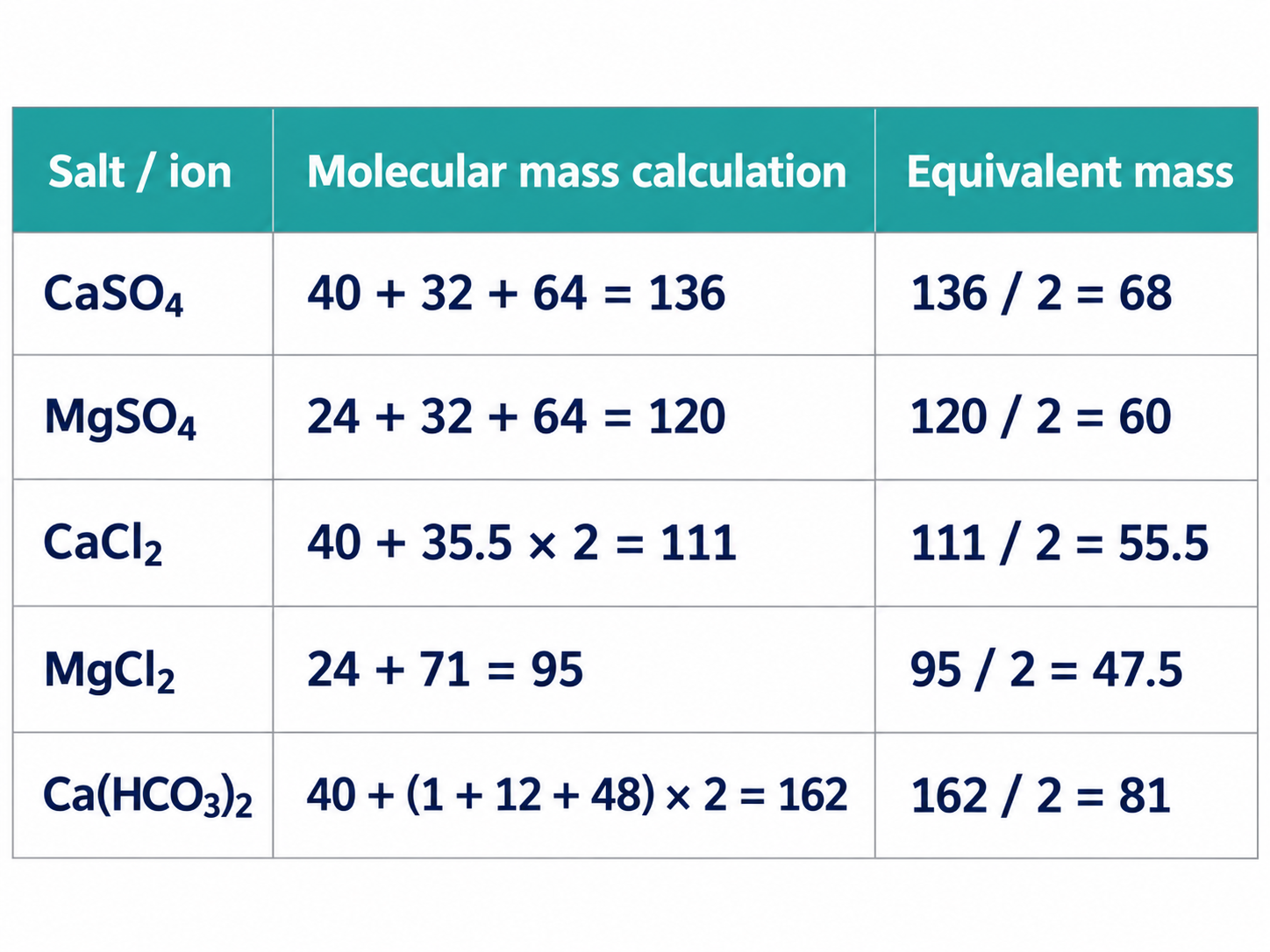
\text{Eq. Wt} \\ \text{Molecular Wt} \\ \text{Eq. Wt. } \text{CaSO}_4 &= 40 + 32 + 1 \times 16 \times 4 \\ &= 72 + 64 \\ &= 136 \end{aligned}$ $\begin{aligned} \text{Equivalent weight} \\ \text{Eq. Wt} \Rightarrow &= \frac{136}{2} = 68 \end{aligned}$ $\begin{aligned} \text{Hardness} &= \frac{\text{Mass of hardness} \\ \text{producing substance}}{\text{Eq. Wt of hardness producing} \\ \text{substance}} \times \text{Eq. Wt. of } \text{CaCO}_3 \\ &= \frac{408 \times 50}{68} = 300\text{ ppm} \end{aligned}$ $\begin{aligned} \frac{408 \times 50}{68} \end{aligned}$ 1. Calculate the temporary & permanent and total hardness of water having following compositions. (i) $\text{Ca(HCO}_3)_2 = 4\text{ ppm}$ (ii) $\text{Mg(HCO}_3)_2 = 6\text{ ppm}$ (iii) $\text{CaSO}_4 = 8\text{ ppm}$ (iv) $\text{MgSO}_4 = 10\text{ ppm}$ ---Page 6 of 83
(i) [illegible]
(i)
(ii)
(iii)
(iv)
Page 7 of 83
Calculate the temporary, permanent and total hardness of water having
ext{NaHCO}_3 &= 23 + 1 + 12 + (16 imes 3) \ &= 24 + 12 + 48 \ &= 36 + 48 \ &= 84 display ext{eq wt} &= rac{84}{1} = 84 ext{hardness of NaHCO}_3 &= rac{3 imes 50}{84} = 1.78 ext{ ppm} ext{Temp hardness} &= ext{Temporary hardness} &= 6.56 + 1.78 = 8.34 ext{ ppm} ext{permanent hardness} &= 14.21 - 1.78 = 12.43 ext{ ppm} ext{Total hardness} &= 8.34 + 12.43 = 20.77 ext{ ppm} --- **NOTE:** If sodium bicarbonate is present in water, temporary hardness increases but corresponding permanent hardness decreases and the total hardness remains same. ---
Page 8 of 83
Q. calculate the temporary and permanent hardness of water which contain , , , , , [uncertain]
,
[uncertain]
Page 9 of 83
A sample of water on analysis gave following results . Calculate the temporary and permanent hardness.
Page 10 of 83
Total hardness =
Temp. hard =
Temporary hardness never exied total hardness, i.e., here temporary hardness = Total hardness
Here, permanent hard =
Q. Calculate the hardness of
(i)
Ans :=
(ii)
Ans := \text{normality} = \text{Molarity} \times \text{charge of positive ion}
Page 11 of 83
(iii)
water softing Methode
Ion exchange process
- It is a water softening method-method to remove hardness causing substances from water
- the ions present in hard water sample are exchanged with those present in ion exchange resins.
Ion exchange resins
- Insoluble, cross linked long chain organic polymers with a micro porous structure.
- The functional groups attached to the chains are responsi-ble for the ion exchange properties
- Two types - cation exchange resin and Anion exchange resins
Page 12 of 83
cation exchange resins
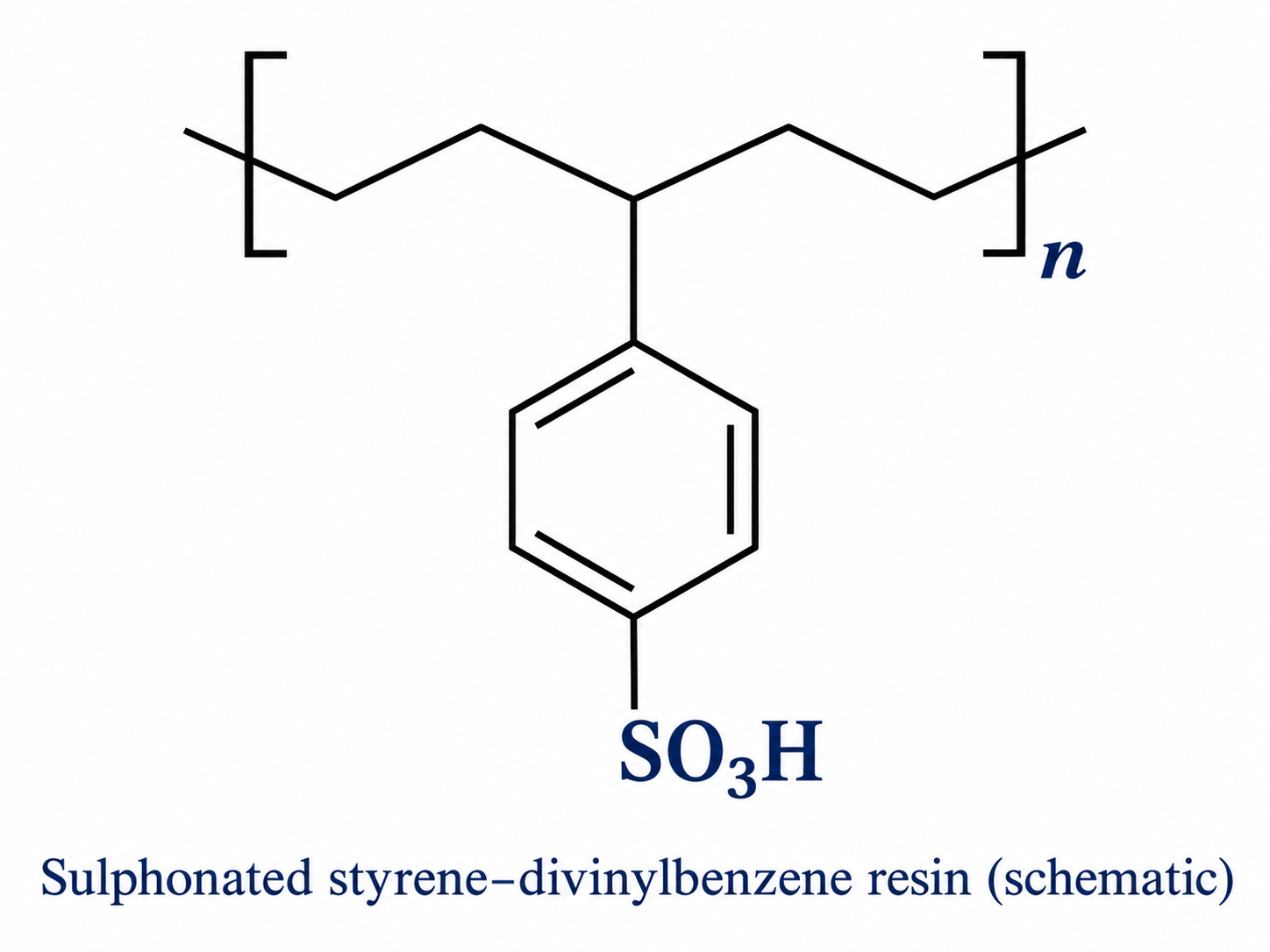
- Resins containing acidic functional group
- able to exchange their ions with other cations, when come in contact with it
- example : styrene-divinyl benzene copolymers
Anion exchange resins
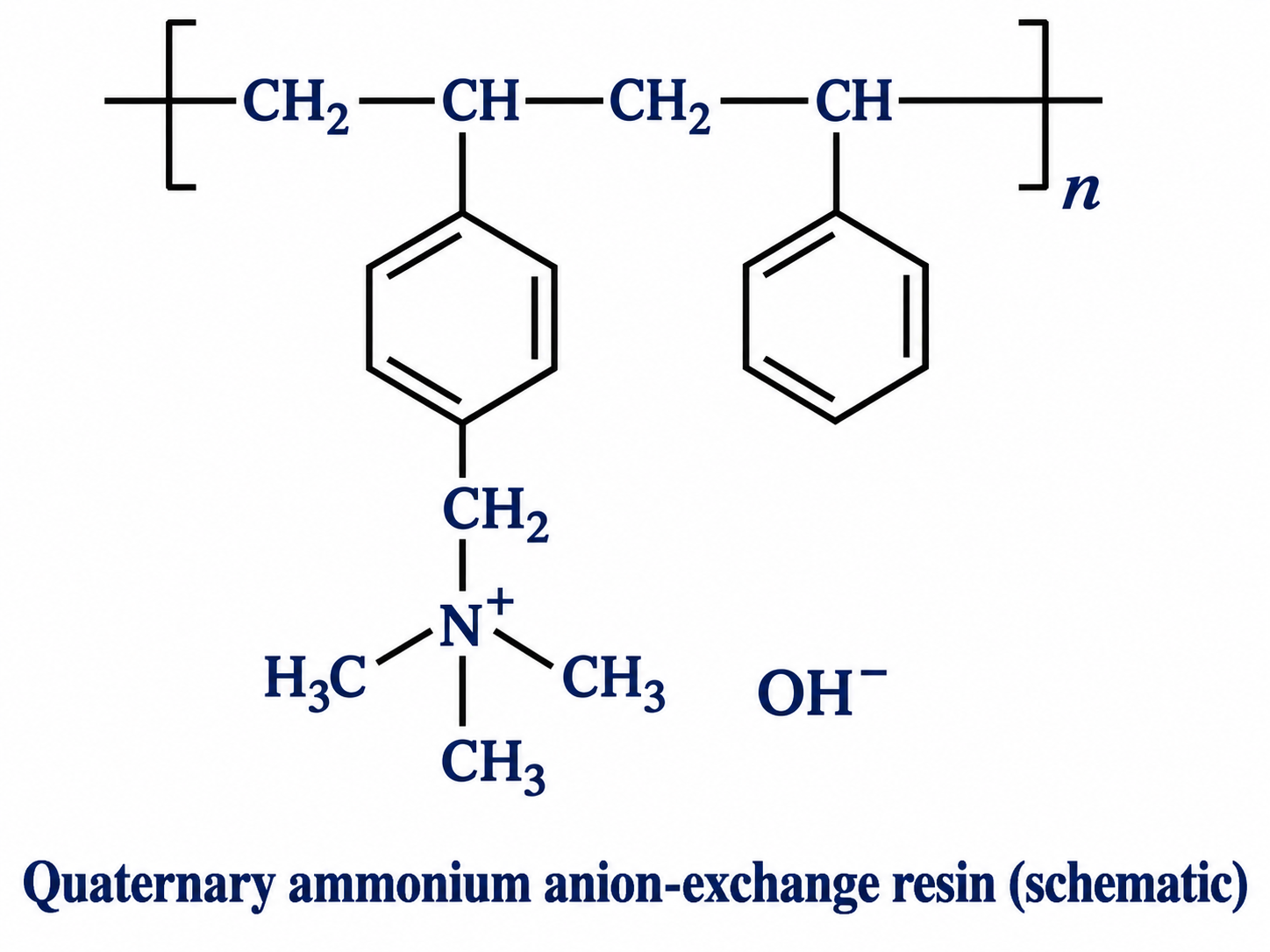
- Resins containing basic functional groups
- Able to exchange their ions with other anions, when come in contact with it
- example : Amine-formaldehyde copolymers
Ion exchange process
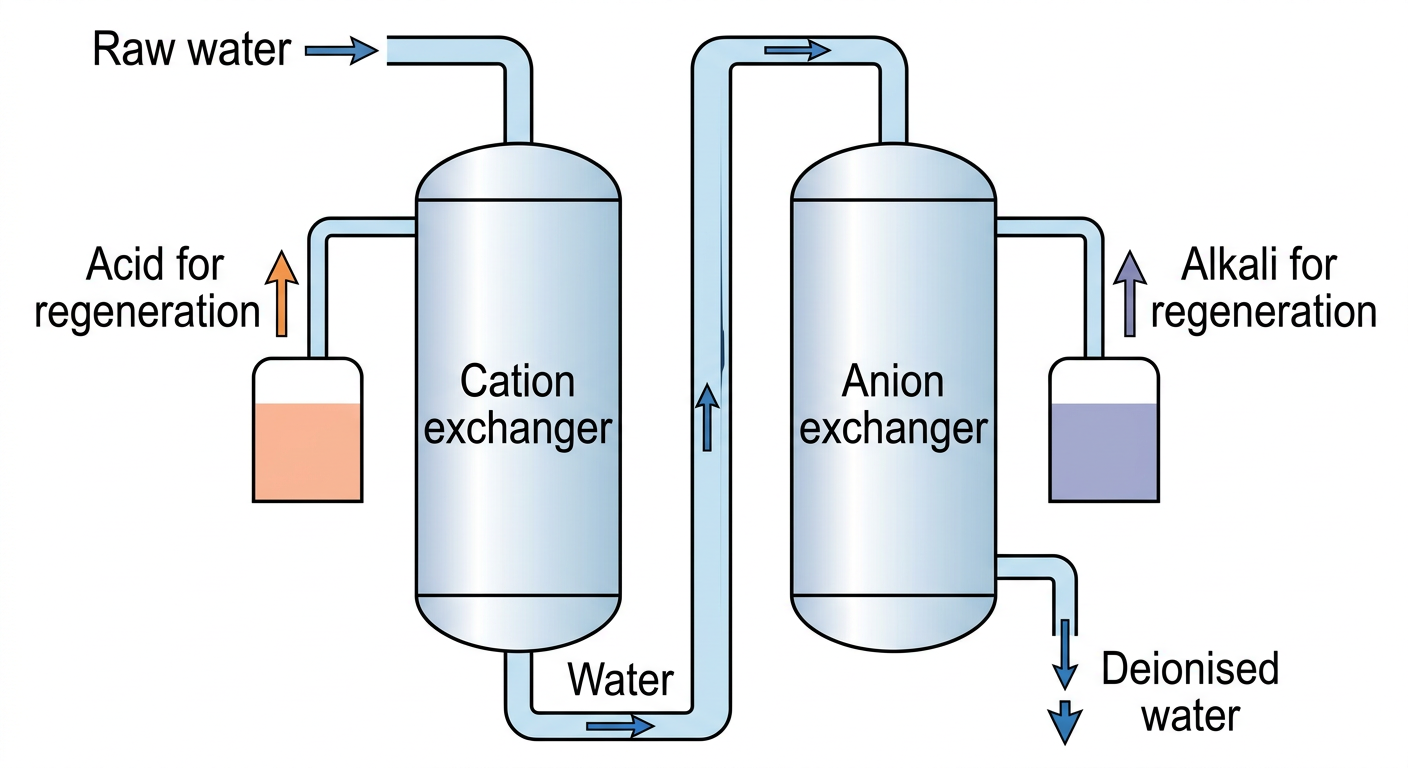
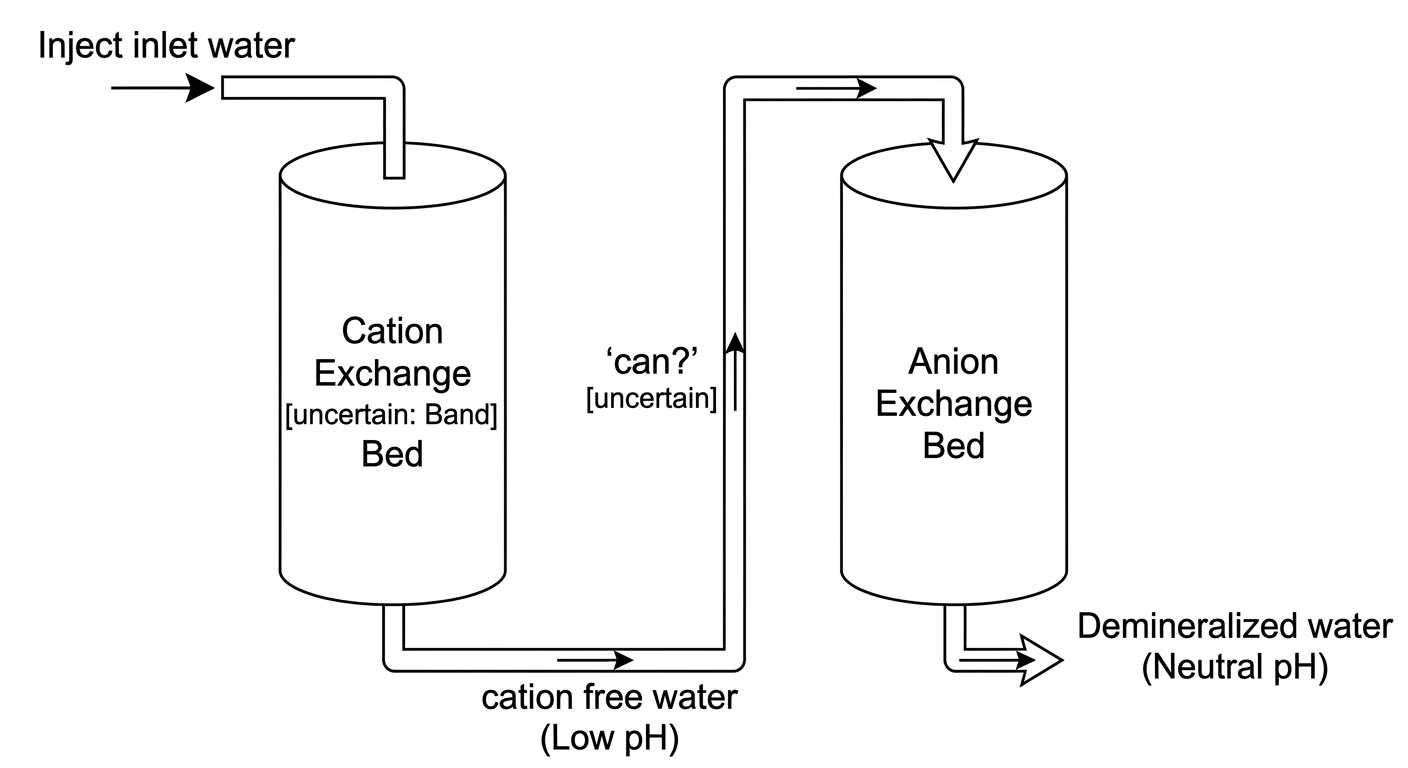
Hard water is first passed through cation exchange column where all the cations like and are removed from it and equivalent amount of ions are realeased from column to water.
cation free water (Low pH)
Demineralized water (Neutral pH)
Page 13 of 83
Then water is passed through anion exchange column where all the anions like and are removed from it and equivalent amount of ions are released from column to water
$\text{2ROH}^- + \text{SO}_4^{2-} \longrightarrow \text{R}_2\text{SO}_4 + \text{2OH}^-$
Thus water coming out from exchanger is free from cation and anion other than and and hence called demineralized or deionized water.
Regeneration of column
When the capacities of cations and anions exchange columns to exchange ions are lost then the columns are said to be exhausted.
- Cation exchange column - by passing dilute acid
- Anion exchange column - by passing dilute alkali
During regeneration, the reaction will be reversed.
Advantages
- Suitable for softening highly alkaline or acidic waters.
- No sludge is formed.
- Resins can be regenerated and reused.
- Deionised water has very low conductivity, so can be used in lead acid battery.
Page 14 of 83
Disadvantages
- Expensive chemicals and costly equipments are needed.
- Turbidity in water lowers the efficiency of softening.
Reverse osmosis
This process is used for removing excess soluble salts from water (desalination)
Osmosis :-
When two solutions of different concentrations are separated by a semi permeable membrane solvent molecules pass from low concentrated region to high concentrated region
Due to osmosis, osmotic pressure is developed in the liquid surface.
Reverse asmosis :-
When a pressure higher than osmotic pressure is applied on the concentrated side, osmosis takes place in the reverse direction.
Page 15 of 83
Desalination of sea water
The sea water which is to be purified is taken in a tank separated by a membrane with pure water. High pressure is applied to sea water to force the pure water out through the membrane, leaving behind the impurities.
Osmosis and Reverse Osmosis
Osmosis
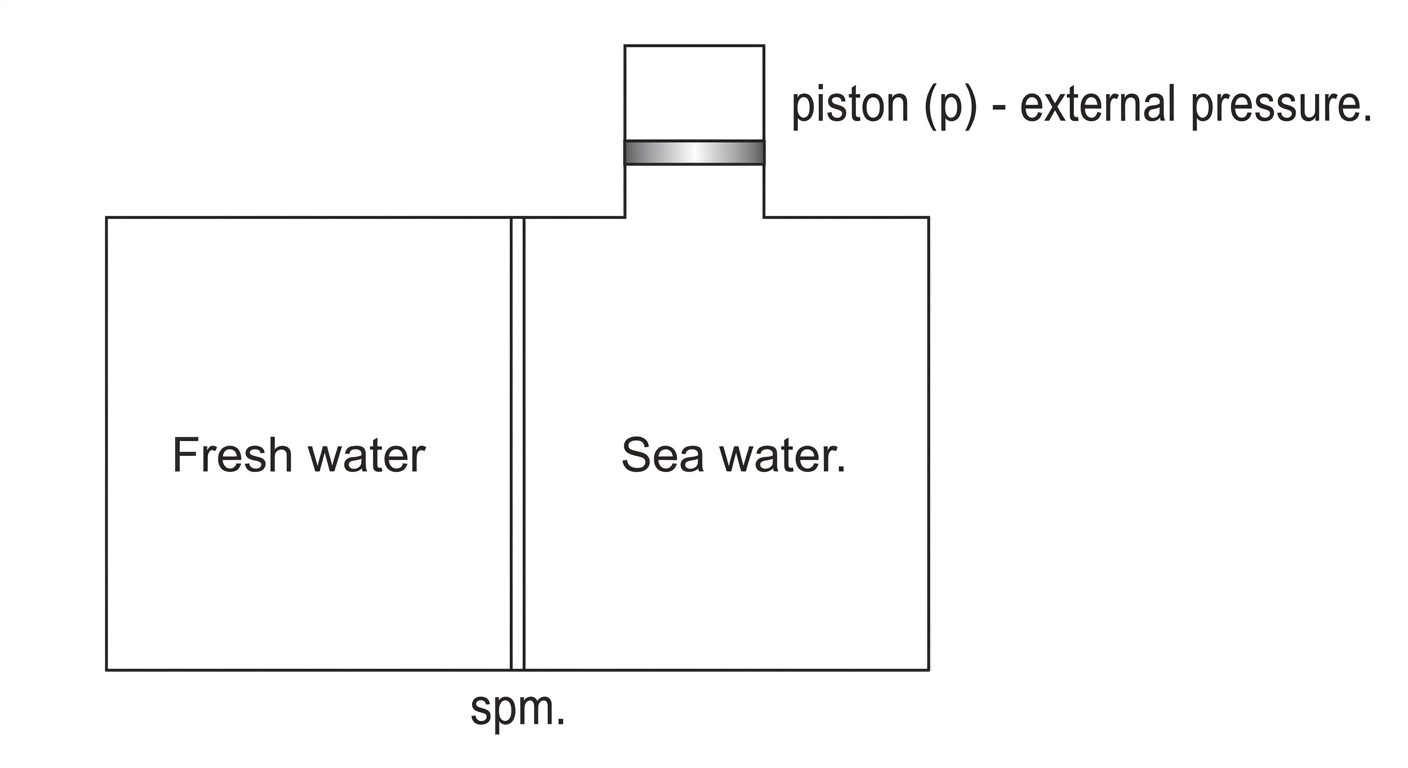
water moves to the side with higher salt content
Reverse Osmosis
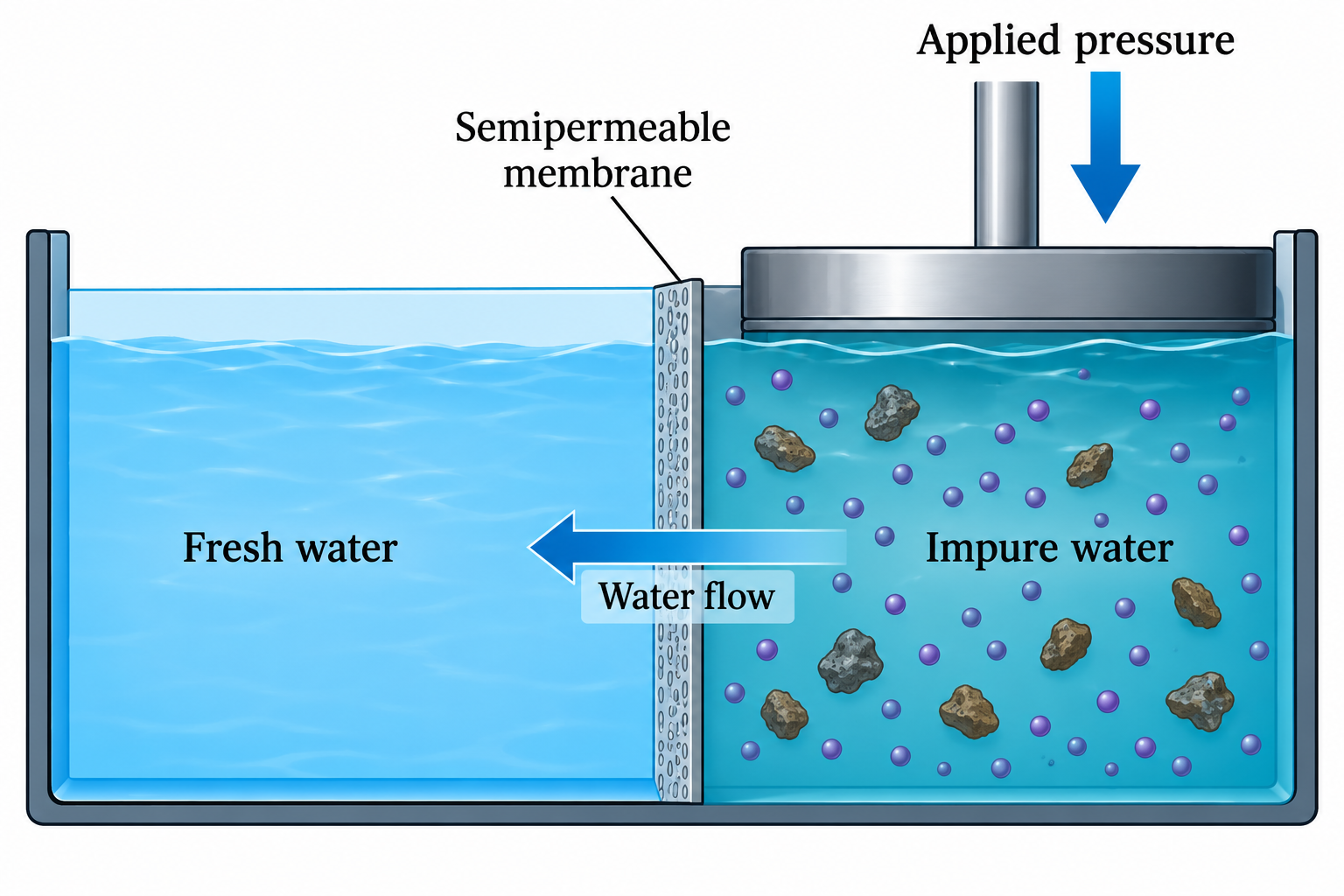
only the water to which external pressure is applied [illegible] through.
Page 16 of 83
Advantages
can remove ions and dissolved organic matter
Low capital cost, maintenance cost is only the replacement of membrane.
No need of regeneration as in the case of ion exchange methods
can remove colloidal sillica which can not be removed by demineralization
does not requires any thermal energy and manual attention
Disadvantage
High consumption of electricity
Disposal of reject is a problem
Purification of water
water purification hence two steps :
-
removal of suspended impurities
(i) screning In screaning process water is passed through a bar screen to remove the floating materials and large sized particle in
Page 17 of 83
(ii) Sedimentation process water is taken in a big tank and kept undisturbed to 5 to 6 hrs during this time most of the dust particles settle down at the bottom. To speed up the sedimentation coagulant like alum is also added.
(iii) Filtration In filteration process water is passed through a sand filter to remove the impurities present in water.
(iv) aeration In aeration process the sufficient amount of air is provided to water oxydation of the impurity is carried out.
- Removal of Micro-organism
The process of removing bacteria and other micro-organism present in water is called disinfection and the chemical is used for this parpase is called disinfection.
(i) Boiling By boiling the water for 5-10 min most of the micro-organisms will be destroyed.
(ii) addition of bleaching powder when bleaching powder is added to water hypo chlorous acid is formed and it act as a disinfectant.
Page 18 of 83
Disadvantages
If bleaching powder added in excess it produce bad smell and taste of water Since calcium deposition takes place it effect the hardness of water It cannot stored it for a long time
(iii) chlorination chlorin is the most commonly used disinfectant in water treatment. chlorin is added to water either in the gaseous form and conc. solution form and it produce HOCl which act has a disinfectant
advantages
It is very effective and economical Since chlorin is stable we can stored it for a long time No Ca deposition takes place, so it does not effect the hardness It can be used at low and high temperature
Disadvantages
Excess chlorin produce bad taste and smell to water
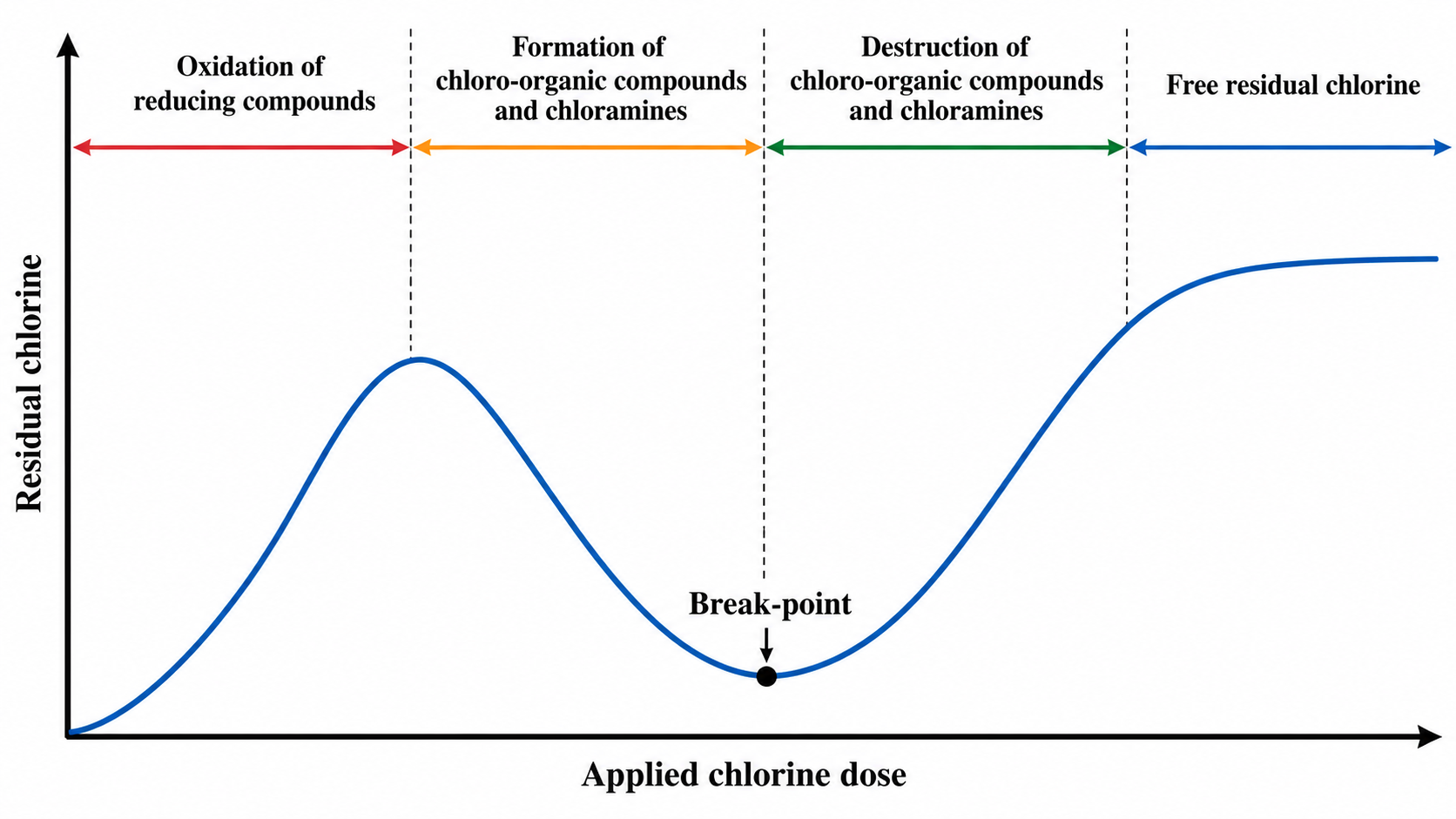
- so in chlorination process chlorin is added to water upto a particular point that is upto break point of chlorination
Page 19 of 83
Break point...
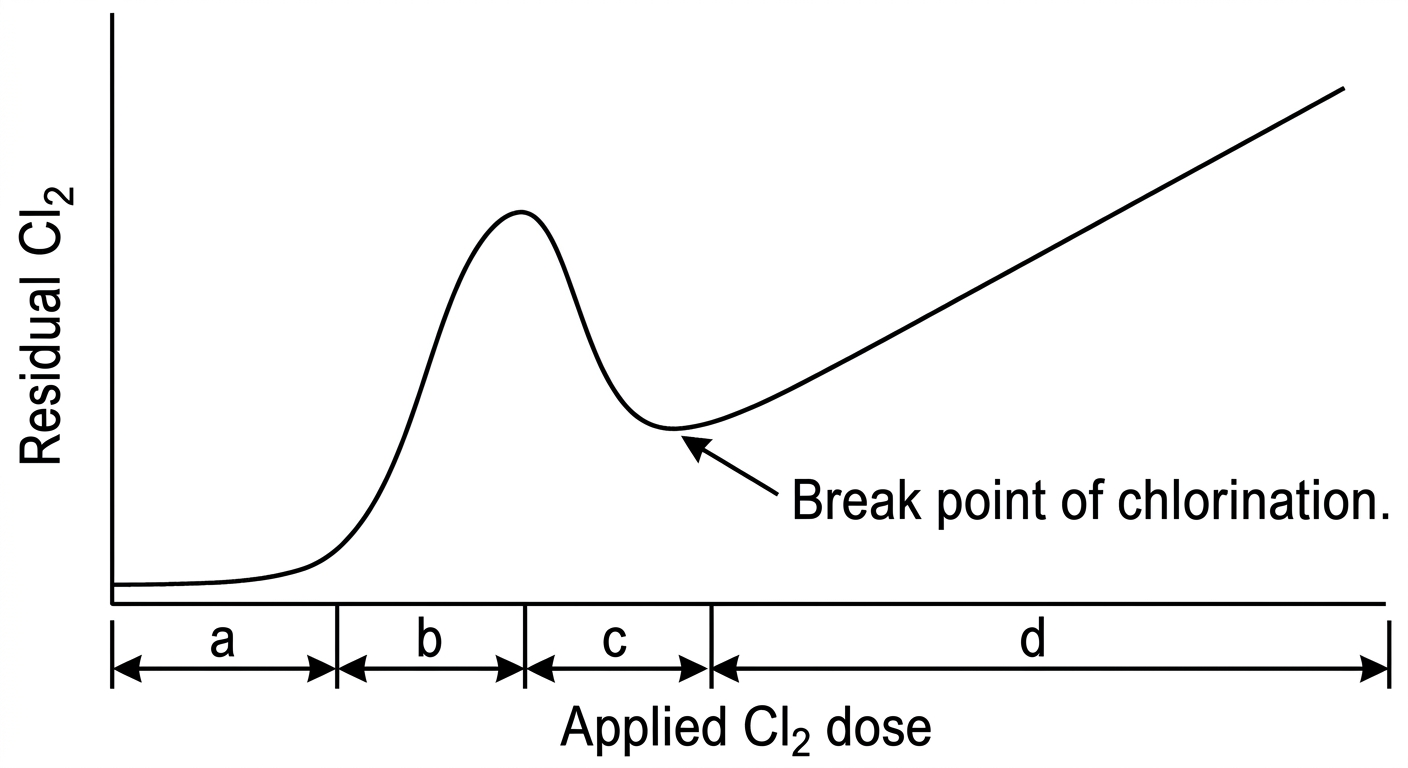
- oxidation of reducing compound by chlorin
- Formation of chloro organic compound and chloramine
- Destruction of chloro organic compound and chloramine.
- Free residual
Break point of chlorination is the addition of chlorin to water such am extent that it destroyes all the micro-organisms are other impurities present in water.
The addition of after break point is called over chlorination and it produce bad taste and smell to water
over is removed by passing the water to a bed of carbon is process is called dechlorination
The addition of at the deep or break is called break point of chlorination.
Page 20 of 83
Advantages of break point chlorination
- It completely oxidised the organic compound, and othe reducing compound
- It remove colours, order and taste from
- It distoryes all the micro organism present in water
- It prevent the growth of any weed weedes in water
(iv) using ozone ozone is obtained by discharge, since the ozone is unstable it decompose to and nascent the nascent is highly reactive and it act as a disinfectant
Since no chemical used in this process, it does not produce any taste and smell to water, but this methode is highly expensive.
(v) By passing uv radiation uv race have very good dismfection action and distroy all the micro-organisms present in water. Since no-chemical used in this process, water does not have any bad smell or taste.
But this methode is highly expensive, and it requires technical skill
Page 21 of 83
treatment.
water pollution
sources of water pollution :
-
Domestic water The houshold waste, muncipal waste released through drains into canals and rivers etc. cause water pollution.
-
Industrial effluents The industrial waste discharged into rivers without proper treatment may contain toxic chemicals. It cause industrial effluents.
-
Agricultural discharges The agricultural dischargers containing several pestisides, fertilizer
sewage
sewage is the liquid waste. it contains aerobic and unaerobic bacterias that bring out the oxidation of orgemic compounds present in it.
Page 22 of 83
| Aerobic | Un-aerobic |
|---|---|
| It take place at presence of oxygen | It take place at in the ab-sence of oxygen |
| It is carried out by aerobic bacterias | It is carried out by unaerobic bacteria |
| Oxidation products are , [crossed out: ] sulphate, nitrate etc. phosphate etc. | Oxidation products are , , at , etc. |
| Non - offensive smell | Offensive smell / pungent smell |
| No biogas fuel is formed | biogas fuel is formed |
| Rate of decomposition is slow | rate of decomposition is fast |
Dissolved oxygen (DO)
It is the level of free non-compound oxygen present in water .
It is the important parameter to determine the water quality. For pure water the D.O level is .
Factors effecting D.O
- Pressure If pressure increases DO level also in-creases. So at higher altitude the water contains lower D.O, due to the lowering of atmospheric pressure.
Page 23 of 83
-
temperature if temperature increases D.O decrease. cold water contain more water than warm .
-
oxidisable pollutants if the amount of pollutense in water
lessincreases D.O level .
The D.O is determine by using winklers titration method or by using D.O meter
Biological oxygen Demand (BOD)
B.O.D is defined as the amount of oxygen required for the Biological oxidation of organic matters present in water under aerobic condition at for a period of 5 days.
It is expressed in mg/L ppm
BOD is used to determine the extent of water pollution.
For seawage BOD value
For pure water BOD value
Page 24 of 83
Chemical Oxygen Demand (COD)
COD is defined as the amount of oxygen required for the complete oxidation of organic and inorganic matters present in water using a strong oxidizing agent that is .
The measurement of COD is 3 hours.
The COD value > BOD
Sewage water treatment
flowchart TD
  A[Sewage] --> B[screening]
  B -->|Residue| C[UASB process]
  B -->|Filterate| D[Sedimentation]
  E[Alum] --> D
  D --> F[Trickling filter process]
  D --> G[Activated sludge process]
  F --> H[chlorination]
  G --> H
  H --> I[precipitation]
The sewage water treatment have 3 steps:
- Preliminary or treatment
- Biological or treatment
- Chemical or treatment
Page 25 of 83
- Preliminary treatment or
(i) screening :- The screening process the sewage is passed through bar screen to remove the floating materials and large sized particle present in the water. The resedue obtained the process undergo anaerobic process (UASB process). The filterate obtained in this process is allowed to sedimentation.
(ii) sedimentation/- In this step the sewage is coll (setting process) ected in a sedimentation tank and kept undisturbed for 5-6 hrs so most of the suspended particle, settle down at the bottom. To speed up the sedimentation coagulant like alum is also added
- Biological treatemet or
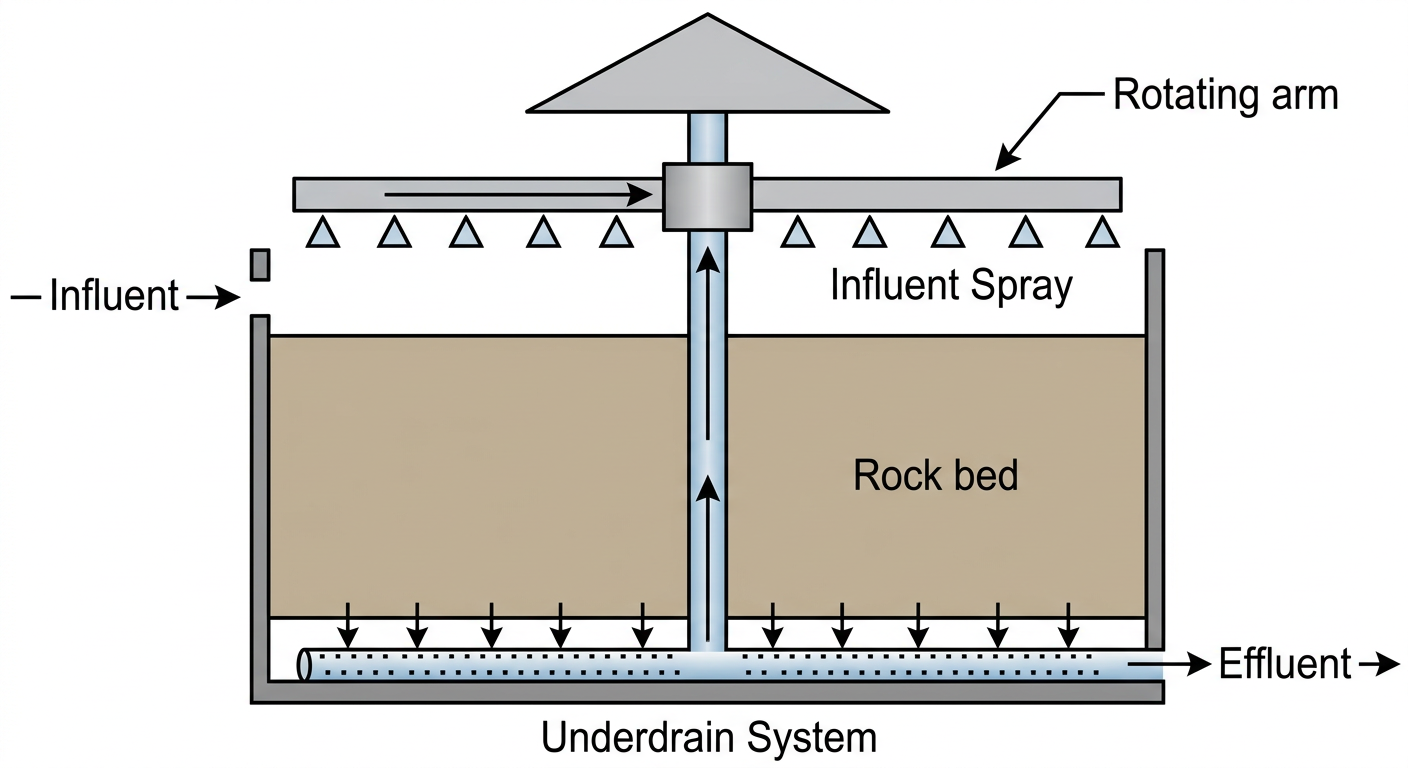
(i) trickling filter process: It involves the biological oxidation of orgemic compound at aerobic condition.
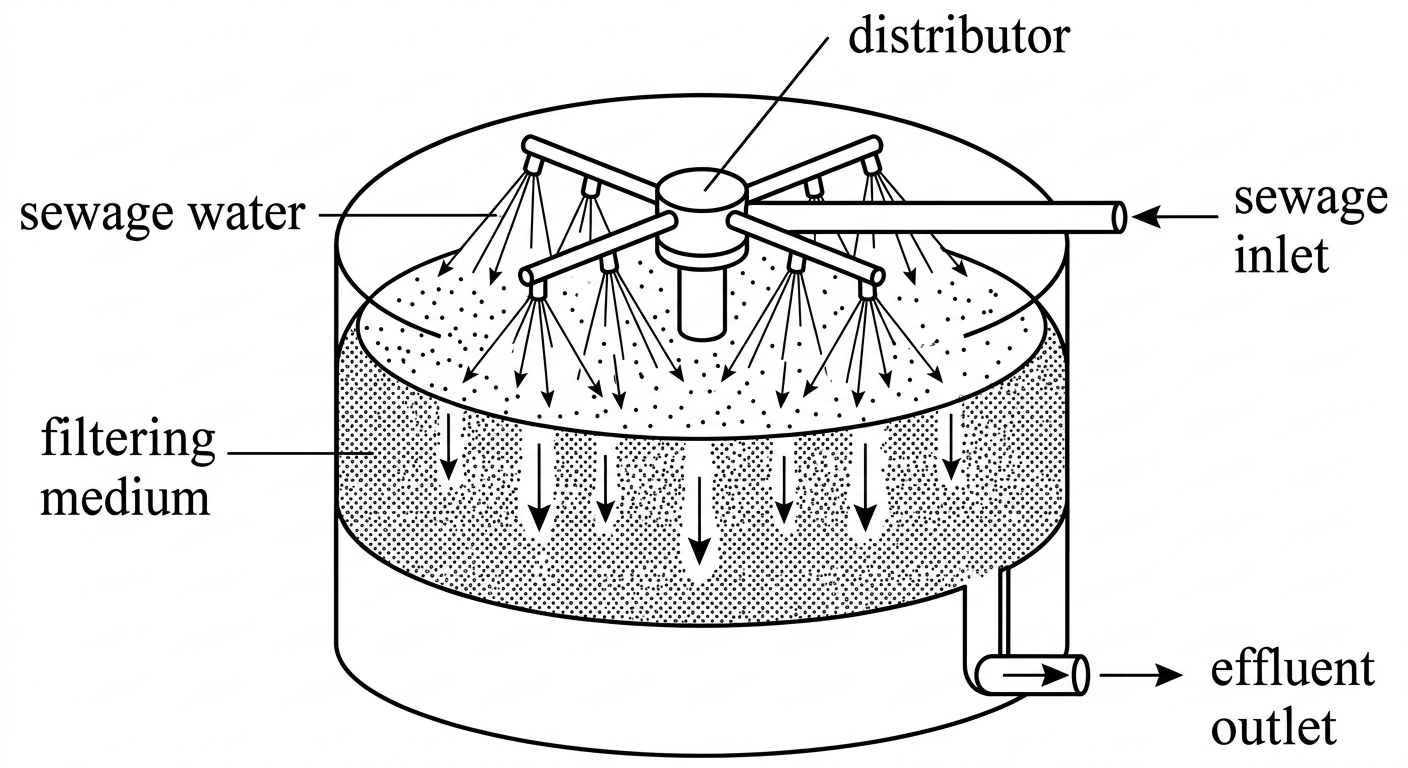
(ii) Trickling filter process (aerobic filteration method) The biological treatment is carried out with the help of trickling filter. The filter is in rectengular in space with about 2m depth it is filled with brocken bricks crushed rocks etc. and fitted with a rotating distributer. This filtering media also contains aerobic bacteria.
Page 26 of 83
The sewage trickle trickles over the filter with rotating distributor, then it's moves down at the filtering media then the aerobic bacteria organic matters present in the sewage, and the effluent is collected from the bottom of the tank.
(ii) Activated sludge process
In this process the sludge is activated by passing sufficient amount of air so the oxidation of sewage is carried out fastly.
Page 27 of 83
- [illegible]
(i) Precipitation
The effluent from the process is treated with so that calcium phosphate get precipitated.
(ii) Chlorination
In chlorination sufficient amount of chlorin is added so that micro organisms will be destroyed. After process treatment the water is send to pond, river etc.
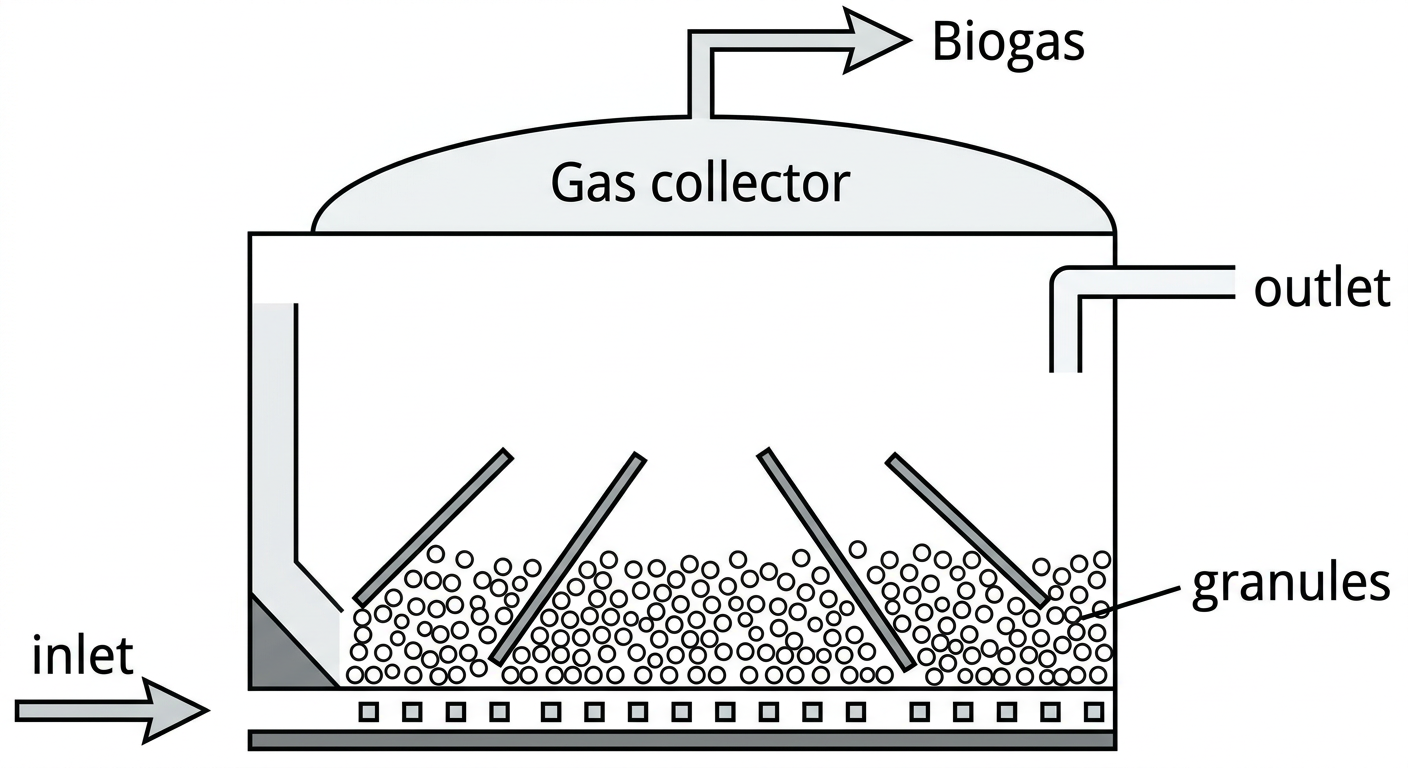
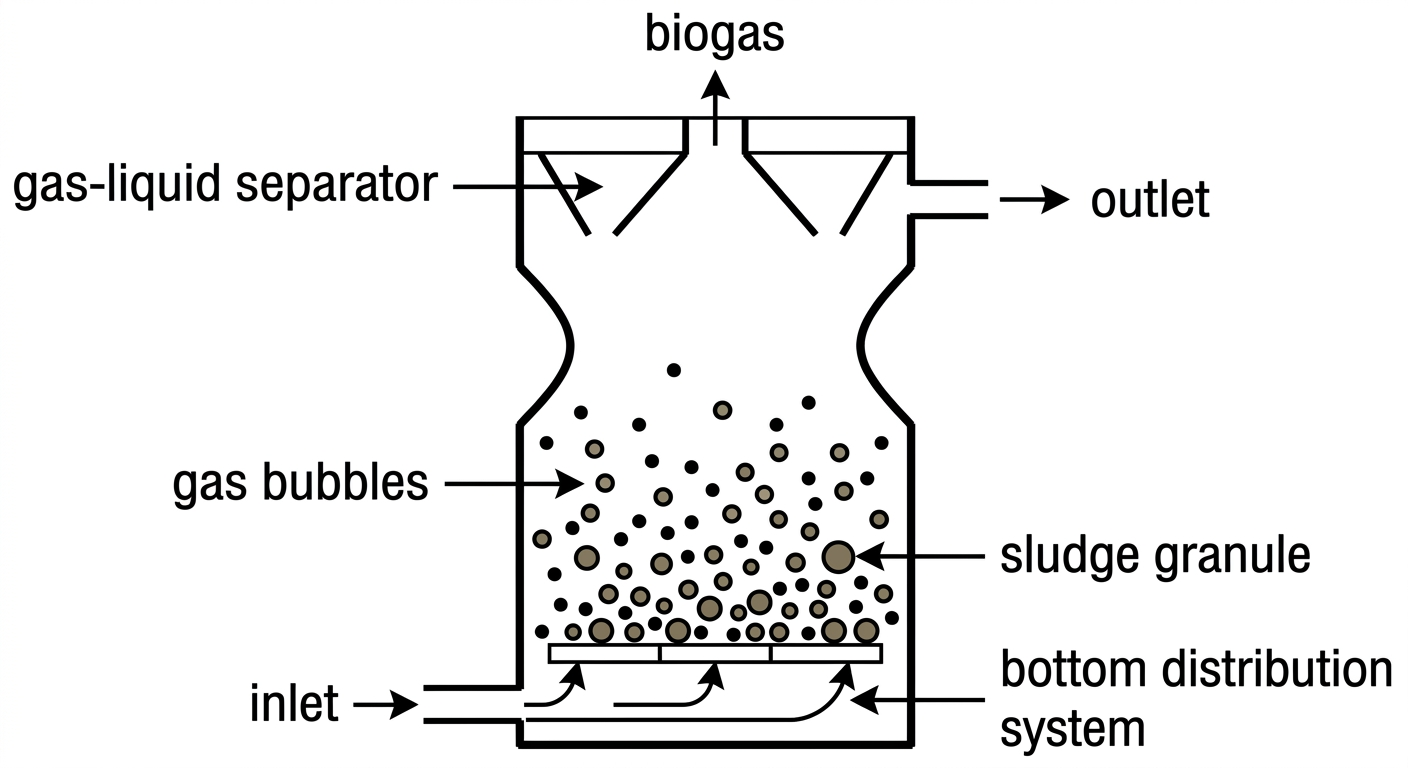
UASB (Upflow Anaerobic sludge Bed) Process
In this methode the residue obtained in process is passed from the bottom of the tank so that it moves upward to the sludge bed. The sludge bed contains anaerobic bacteria when the waste comes in contact with the bacterias the anaerobic oxidation of the impurities is carried out .Here, biogas fuel is obtained as a biproduct and is collected by using a pipeline and treated effluent collected by using an outlet.
Page 28 of 83
[Non-content page]
Page 29 of 83
Module - 4
Environmental Chemistry
HARD WATER:
- Water which does not produce lather with soap.
- Hard water contains salt of calcium or magnesium and heavy metals.
TYPES OF HARD WATER:
- TEMPORARY HARDNESS
- It is due to the presence of bicarbonates of Ca or Mg. So this hardness is known as bicarbonate hardness.
- Salts are calcium bicarbonate () and magnesium bicarbonate ().
- Temporary hardness can be removed by boiling method.
- PERMANENT HARDNESS:
- It is due to presence of chlorides and sulphates of calcium or magnesium.
- Salts are , , , .
- Permanent hardness can be removed by lime-soda process and ion-exchange process.
Page 30 of 83
REACTION OF SOAP WITH HARD WATER:
DEGREE OF HARDNESS:
↳ Hardness of water is usually expressed in terms equivalent of calcium carbonate. Calcium carbonate is taken as standard because:
(i) is the most insoluble precipitate formed during water treatment.
(ii) Its molecular weight is and equivalent weight is .
↳ Hardness equivalent to
$\rightarrow \text{Equivalent weight} = \frac{\text{molecular weight}}{\text{charge of } +\text{ve ion}}$
UNIT OF HARDNESS:
- ppm (parts per million)
- (milligram per litre)
Q. The given water sample contains of per litre. Calculate the hardness equivalent to :
Page 31 of 83
ans. Hardness equivalent to = rac{ ext{Mass of hardness producing salt} imes 50}{ ext{equivalent weight of hardness producing salt}}
equivalent weight of = rac{136}{ rac{2}{ ext{(charge of +ve ion)}}} ext{(Molecular weight of } CaSO_4)
=
Hardness = rac{408 imes 50}{68}
=
Q. Calculate the hardness of water sample containing calcium bicarbonate ().
ans. Hardness = rac{ ext{Mass of hardness producing salt} imes 50}{ ext{equivalent weight of hardness producing salt}}
equivalent weight = rac{162}{2}
=
Hardness = rac{4 imes 50}{81}
=
Q. Calculate temporary, permanent and total hardness of water having following composition:
ans. (i) ; ; ; .
equivalent weight of = rac{40 + 2 + 12 imes 2 + 16 imes 6}{2} = rac{162}{2} = 81
equivalent weight of = rac{24 + 2 + 24 + 96}{2} = rac{146}{2} = 73
equivalent weight of = rac{40 + 32 + 64}{2} = rac{136}{2} = 68
Page 32 of 83
equivalent weight of ext{MgSO}_4 = rac{24+32+64}{2} = rac{120}{2} = 60
Hardness: ext{Ca(HCO}_3)_2 = rac{4 imes 50}{81} = 2.46 ext{ ppm} ext{Mg(HCO}_3)_2 = rac{6 imes 50}{73} = 4.10 ext{ ppm} ext{CaSO}_4 = rac{8 imes 50}{68} = 5.88 ext{ ppm} ext{MgSO}_4 = rac{10 imes 50}{60} = 8.33 ext{ ppm}
(ii) ; .
equivalent weight of ext{MgCl}_2 = rac{24 + 35.5 imes 2}{2} = rac{95}{2} = 47.5
equivalent weight of are respectively.
Hardness: ext{Ca(HCO}_3)_2 = rac{8.1 imes 50}{81} = 5 ext{ mg/L} ext{Mg(HCO}_3)_2 = rac{14.6 imes 50}{73} = 10 ext{ mg/L} ext{CaSO}_4 = rac{13.6 imes 50}{68} = 10 ext{ mg/L}
Page 33 of 83
ext{MgCl}_2 = rac{19 imes 50}{47.5} = 20 ext{ mg/l}
ext{Temporary Hardness} &= 5 + 10 \ &= 15 ext{ mg/l} \ ext{Permanent hardness} &= 10 + 20 \ &= 30 ext{ mg/l} ext{Total Hardness} &= 15 + 30 \ &= 45 ext{ mg/l} (iii) & ext{Ca(HCO}_3)_2 = 4 ext{ ppm} \; ext{; ext{ } ext{Mg(HCO}_3)_2 = 6 ext{ ppm} \; ext{; ext{ } ext{CaSO}_4 = 8 ext{ ppm} \; ext{; ext{ } ext{MgSO}_4 = 10 ext{ ppm} \; ext{; ext{ } ext{Na}_2 ext{SO}_4 ext{ NaHCO}_3 = 3 ext{ ppm}. ightarrow ext{equivalent weight of } ext{NaHCO}_3 &= 23 + 1 + 12 + 16 imes 3 \ &= rac{84}{1} ext{Hardness :} ext{Ca(HCO}_3)_2 &= 2.46 ext{ ppm} \ ext{Mg(HCO}_3)_2 &= 4.10 ext{ ppm} \ ext{CaSO}_4 &= 5.88 ext{ ppm} \ ext{MgSO}_4 &= 8.33 ext{ ppm} \ ext{NaHCO}_3 &= 84 imes rac{3 imes 50}{84} = 1.78 ext{ ppm} ext{Temporary Hardness} &= 2.46 + 4.10 + 1.78 \ &= 8.34 ext{ ppm} ext{Permanent Hardness} &= 5.88 + 8.33 ext{ ext{Total hardn}} \ &= 14.21 ext{ ppm} ext{Total Hardness} &= 2.46 + 4.10 + 5.88 + 8.33 \ &= 20.77 ext{ ppm} ext{When } ext{NaHCO}_3 ext{ present in water temporary hardness} \ ext{increases but total hardness remains the same.} ext{Permanent hardness} &= ext{Total hardness} - ext{Temporary hardness} \ &= 20.79 - 8.34 \ &= 12.45 ext{ ppm} ---Page 34 of 83
(iv) , , , , , .
Total hardness is due to and ions. Temporary hardness is due to .
Q. Calculate the hardness of:
(i) solution.
(ii) solution
Page 35 of 83
\text{Hardness} &= 0.1 \times 50 \times 1000 \\ &= 5000\text{ mg/L} \end{aligned}$ (iii) $0.02\text{ M } \text{Al}_2(\text{SO}_4)_3 \text{ solution}$: $\begin{aligned} \text{Normality} &= 0.02 \times (3 \times 2) \\ &= \text{--}0.06\text{ N } 0.12\text{ N} \end{aligned}$ $\begin{aligned} \text{Hardness} &= \text{--}\frac{12}{0.06} \times 50 \times 1000 \\ &= 3000\text{ ppm} \\ &= 6000\text{ ppm} \end{aligned}$ ## ION EXCHANGE METHOD (WATER SOFTENING METHOD) ↳ Ion exchange process is a reversible chemical reaction where an ion from the solution (hard water) is exchanged for a similarly charged ion attached to an immobile solid particle (polymer or resin). ↳ The used resin is styrene-divinyl benzene copolymer. ↳ It has: * cross linked structure * porous * High molecular weight * with exchangeable ion attached to polymers. ↳ Ion exchanged resins are two types 1. $\text{CATION EXCHANGE } \text{ION RESIN } (\text{RH}^+)$ $\rightarrow$ Styrene-divinyl benzene copolymer is treated with sulphonic acid $(\text{SO}_3\text{H})$. Then $\text{SO}_3\text{H}$ group get attached to the polymer. 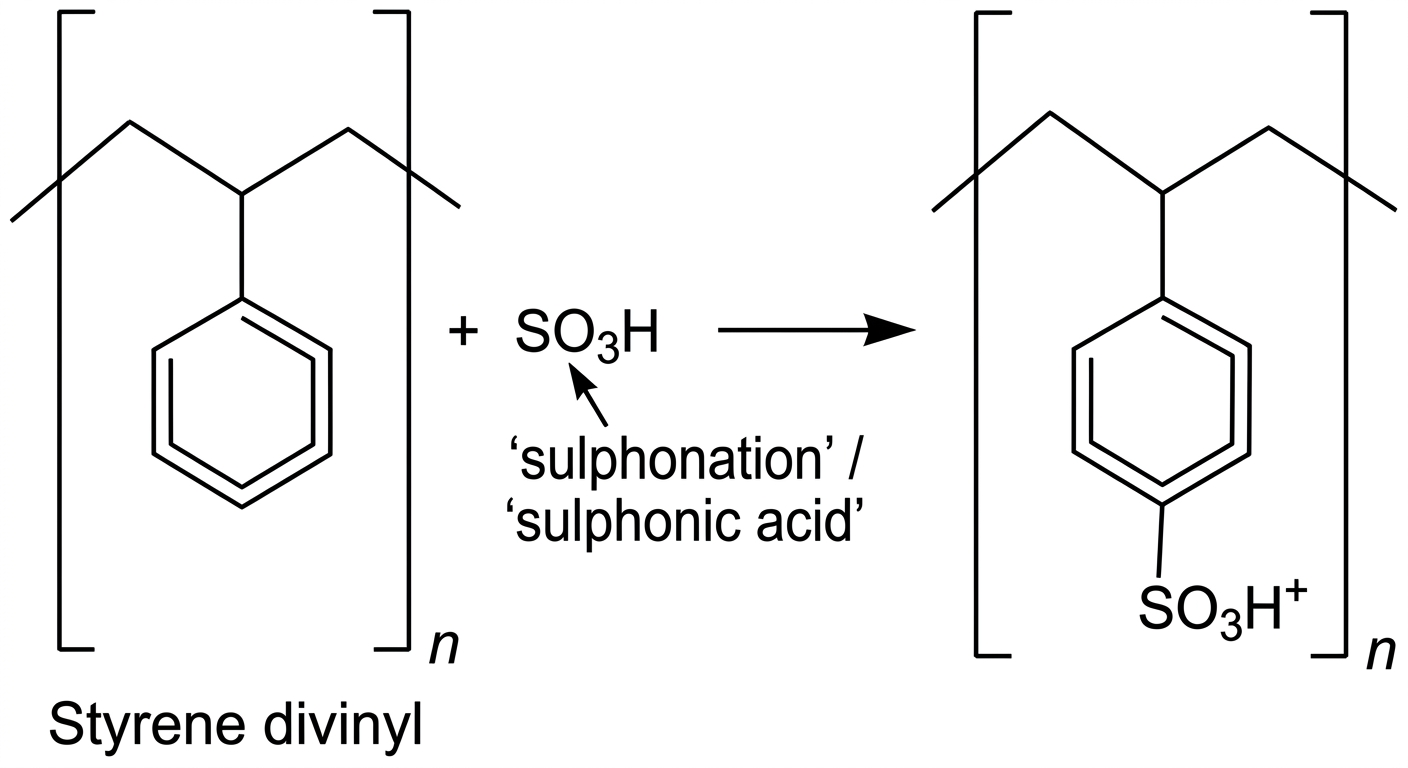 2. $\text{ANION EXCHANGE RESIN } (\text{R}^+\text{OH}^-)$ $\rightarrow$ Quatenery ammonium group attached styrene divinyl benzene copolymer is treated with $\text{NaOH}$. The $\text{OH}$ group get attached to the polymer. 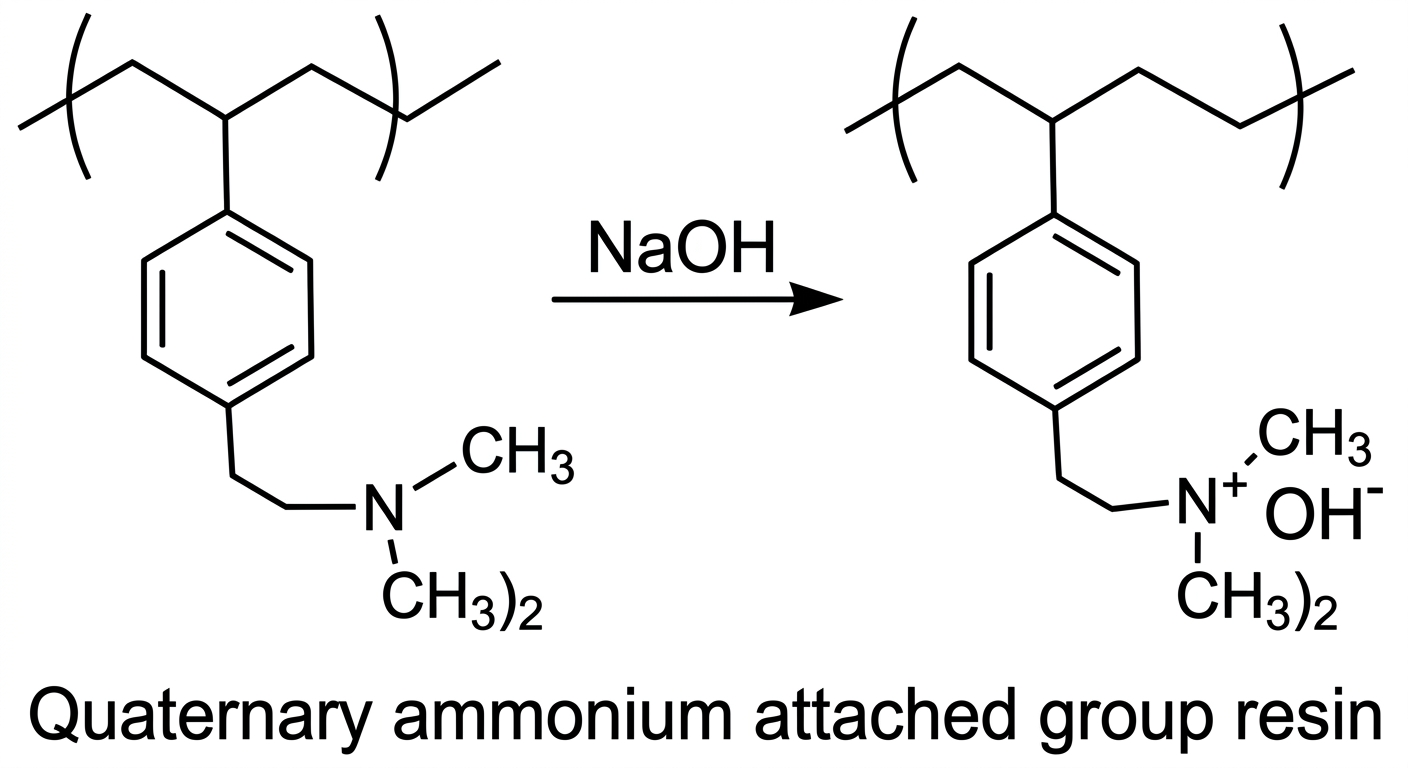 ---
Page 36 of 83
↳ PROCESS :
→ Hard water is first passed through cation exchange column where all the cation present in the water exchanged with ions attached to the resin.
→ After the first process hard water is passed through anion exchange column where all the anions present in the hard water exchanged with ions attached to the polymer.
$2\text{R}^+\text{OH}^- + \text{SO}_4^{2-} \longrightarrow \text{R}_2\text{SO}_4 + 2\text{OH}^-$
→ and ions are liberated from cation and anion exchangers respectively, combined together to produce water molecule.
This water is known as demineralised water or deionised water.
↳ REGENERATION OF COLUMNS :
↳ Cation exchange column can be regenerated by adding or
↳ Anion exchange column can be regenerated by adding solution.
Page 37 of 83
It can be used to soften even acidic or alkaline waters. Treated water has residual hardness of only. No sludge is formed. The resins can be regenerated or reused.
DISADVANTAGE: Equipments and chemicals used are costly. Turbid water cannot be treated by this method:
DESALINATION OF BRACKISH WATER
REVERSE OSMOSIS:
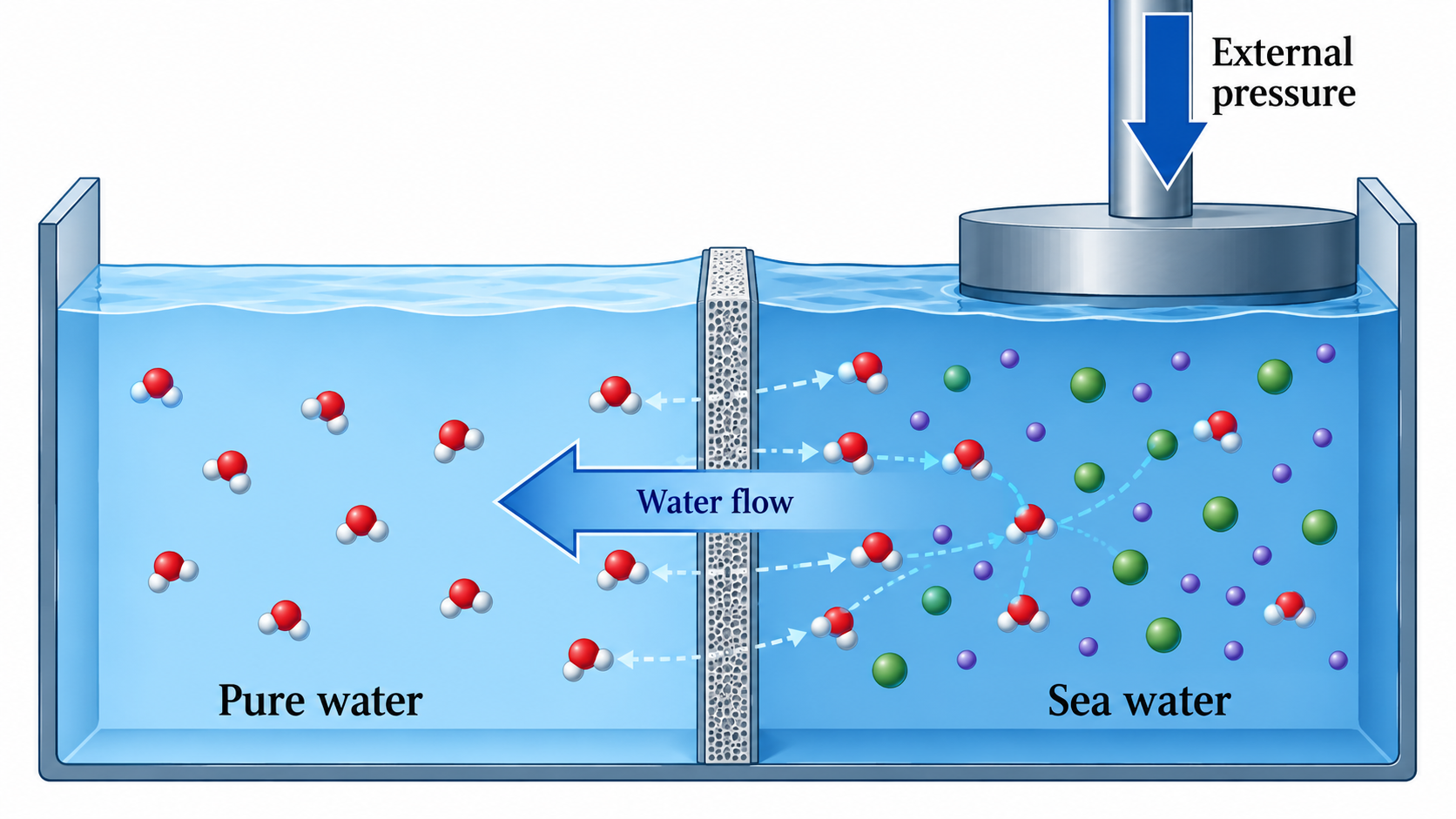
When two solutions of unequal concentration are separated by a semipermeable membrane, in reverse osmosis, a pressure greater than osmotic pressure is applied on higher concentration side (sea water) Then, water from higher concentration side moves to lower concentration side (pure water) through semipermeable membrane.
ADVANTAGES: Simple process low operating cost used to remove salty impurity, colloidal silica, organic - inorganic contaminants from water.
Page 38 of 83
Energy requirement 30% lower than distillation process.
WATER DISINFECTION METHOD :
The removal of disease causing pathogens from water is known as disinfection. The chemicals used for disinfection are known as disinfectants. The methods are:
(i) CHLORINATION: Chlorine in the form of gas or concentrated solution is added to water. Hypochlorus acid can deactivate the enzyme present in microorganisms. Chlorination is carried out in an apparatus called chlorinator. Factors affecting chlorination:
- Time in contact - The rate of killing of microorganism is maximum at the beginning and goes on decreasing with time.
- Temperature - temperature increases, death rate of microorganism also increases.
- - At a lower , chlorination is more effective.
ADVANTAGES:
- Simple process
- Low cost method
- Storage is easy
- Does not introduce salty taste to water
DISADVANTAGE:
- Chlorine added in excess cause unpleasant taste, odour
Page 39 of 83
and irritation mucus membrane.
BREAKPOINT CHLORINATION:
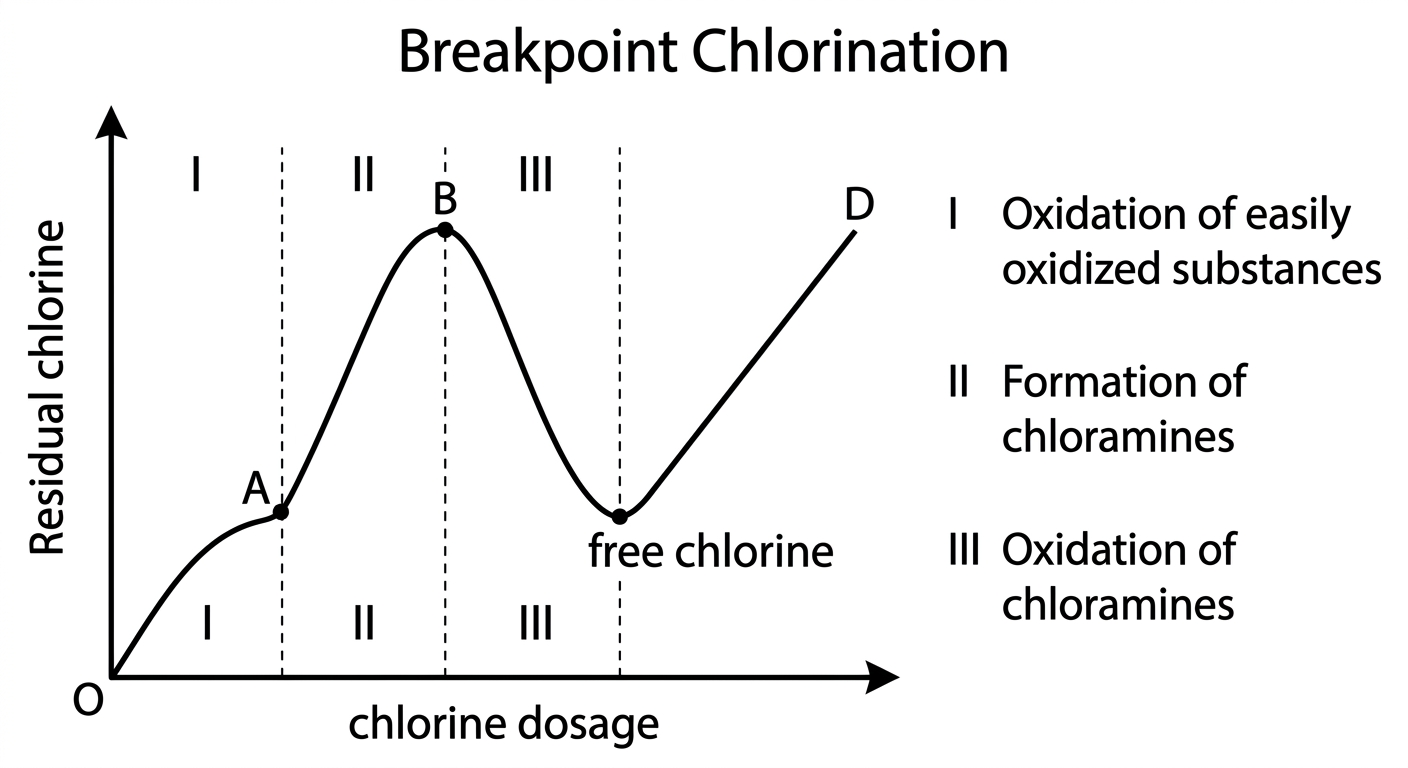
I. Oxidation of reducing compounds by chlorine.
II. Formation of chloro organic compounds and chloroamines.
III. Destruction of chloro organic compounds and chloroamines.
Breakpoint chlorination refers to addition of chlorine to water in amount sufficient to kill all microorganisms and destroy it completely by oxidation.
Impurities like organic matter, reducing substance, colouring matter, free ammonia also get oxidised and destroyed.
ADVANTAGES:
- It removes colour, odour and taste from water.
- It destroys all disease causing pathogens in water.
- completely oxidise organic compounds.
DECHLORINATION: Over chlorination can be removed by adding sulphur dioxide (), sodium sulphite, sodium thiosulphate, etc.
(ii) CHLOROAMINE ADDITION :
When chlorine and ammonia are mixed in 2:1 ratio, chloroamine is formed.